Insights
What is a micro GCC, and when does it make sense?
A micro GCC is a wholly controlled, directly governed offshore team of roughly five to twenty-five professionals, working under the owning company's own brand, management structure and quality standards, usually in an established Indian city. It is not outsourcing, and it is not body shopping.
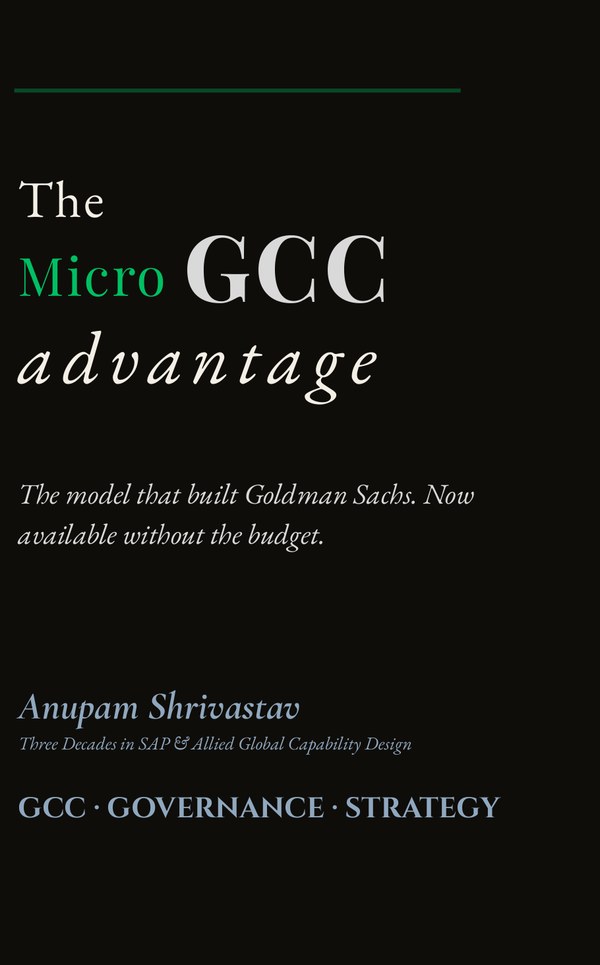
The definition follows The Micro-GCC Advantage by Anupam Shrivastav (2026), which is written for small and mid-sized businesses. A global capability center (GCC), also called a captive center, is the same idea at larger scale: an offshore unit the company owns and runs itself.
What makes it different
- Employed directly. The professionals are employees of the company, through its own Indian subsidiary or through a compliant employer-of-record arrangement. They work only for it.
- Governed directly. The company sets the performance standards, the career framework, the working culture and the mandate.
- Owned knowledge. What the team learns stays with the company, instead of leaving with an agency's staff.
How it differs from body shopping
In body shopping the talent belongs to an agency. The agency sets employment terms, controls the career, and can move the person to another client. The client pays a marked-up rate that covers the agency's recruitment cost, overhead, margin and profit. The book also notes that an agency-placed person may be billed to several clients at once, with no visibility for any of them. In a micro GCC the person is a direct employee, so that cannot happen. The body-shopping model rents capability. A micro GCC builds it.
How it differs from a large GCC
The book describes four scale tiers: the micro GCC at 5 to 25 people, a growth GCC at 25 to 100, a scale GCC at 100 to 500, and an enterprise GCC above 500. Governance demands rise with size. At around 150 people the book says the center needs a dedicated India-side managing director and formal governance.
Why it starts as a team
The book gives a working reference of eight to twelve professionals in the same functional area as the point where fixed governance costs are absorbed by the volume of work. Below that, compliance and management overhead per person is high and can cancel part of the saving. A single person employed in India as a standalone entity is, in the book's words, a compliance liability and a management overhead. The model works as a team.
When it makes sense
- There is work the company needs done continuously, at scale or needing deep expertise, that it cannot do as well or as efficiently at home.
- The volume justifies a dedicated team, and the skills are available in India.
- The company wants to own and build capability, and can govern a team at that level of autonomy.
When it does not
- The work can be done at head office at comparable cost.
- The volume does not justify the fixed costs of a standalone team.
- The expertise is so specialised that no talent pool outside the home market can supply it.
- The goal is only a quick cost cut, with no plan to build ownership.
Next: how a micro GCC is set up in seven days, what the numbers say against agency staff, and how to decide whether to build, fix or walk away. Terms are in the glossary.
All insights