Insights
Glossary: GCC, offshore and SAP terms
Short definitions in plain language, as Altacent Partners uses the terms.
- Global capability center (GCC)
- An offshore unit that a company owns and runs to do work for its parent group, such as IT, finance, engineering or analytics. Also called a captive center or global in-house center.
- Micro GCC
- A wholly controlled, directly governed offshore team of about five to twenty-five professionals, working under the owning company's own brand and standards. The definition follows the book The Micro-GCC Advantage.
- Body shopping
- A staffing arrangement in which an agency employs the professionals and places them with clients at a marked-up rate. The talent belongs to the agency, not the client.
- Employer of record (EOR)
- A provider that legally employs staff in a country on a company's behalf, handling payroll and statutory compliance, so a team can start before the company has its own local entity.
- Captive center
- Another name for a GCC: an offshore center owned by the company it serves, as opposed to a vendor's center.
- Offshore delivery
- Doing work for a client from another country, usually to access skills or lower costs. It can be done through a vendor, a captive center or a mix.
- Outsourcing
- Buying a service from an outside vendor who employs the people and is paid under a contract.
- Build-operate-transfer (BOT)
- An arrangement in which a partner builds and runs a center for a period, then transfers it to the client, who then owns it.
- Carve-out
- The separation of a business unit from its parent company, for example when an investment firm buys it. IT and shared services usually have to be separated or replaced.
- Transition services agreement (TSA)
- A temporary contract under which a seller keeps providing services, such as IT, to a carved-out business until it can run on its own.
- SOC 2
- An independent audit report on how a service organization protects data, covering security, availability and related controls. Clients often ask for it from offshore centers.
- IT general controls (ITGC)
- The basic controls over IT systems, such as access, change management and operations, that auditors test to rely on a company's financial systems.
- Segregation of duties (SoD)
- A control that stops one person from holding combinations of access that allow error or fraud, such as creating a supplier and approving its payment.
- Governance, risk and control (GRC)
- The policies, systems and checks that manage access, risk and compliance across an enterprise, including in SAP.
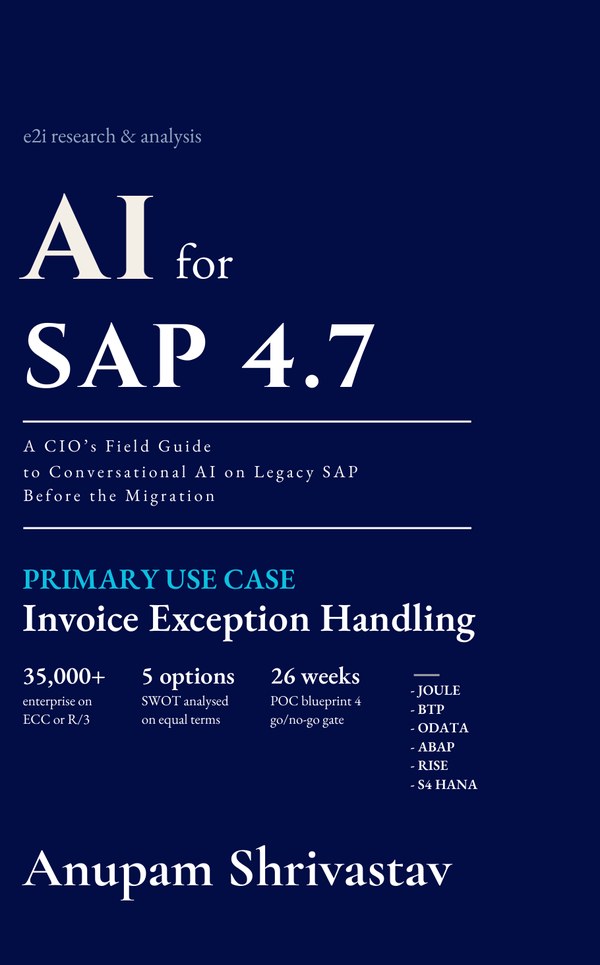
- SAP ECC and R/3
- Earlier generations of SAP's enterprise software that came before S/4HANA. R/3 dates from the 1990s and ECC followed it. Many companies still run them.
- SAP BTP
- SAP Business Technology Platform, SAP's cloud platform for integration, extension, data and AI, including the Joule assistant.
- SAP Joule
- SAP's AI assistant, which answers questions and completes tasks in plain language across SAP cloud products.
- Robotic process automation (RPA)
- Software bots that operate application screens the way a person would, used to automate routine tasks without changing the underlying system.
- SAP S/4HANA
- SAP's current enterprise software suite for finance, supply chain, manufacturing and other core processes.
- Procurement platform
- Software that manages buying and supplier processes. Ariba, Coupa and Ivalua are widely used examples.