Insights
Micro GCC or agency staff: what the numbers say
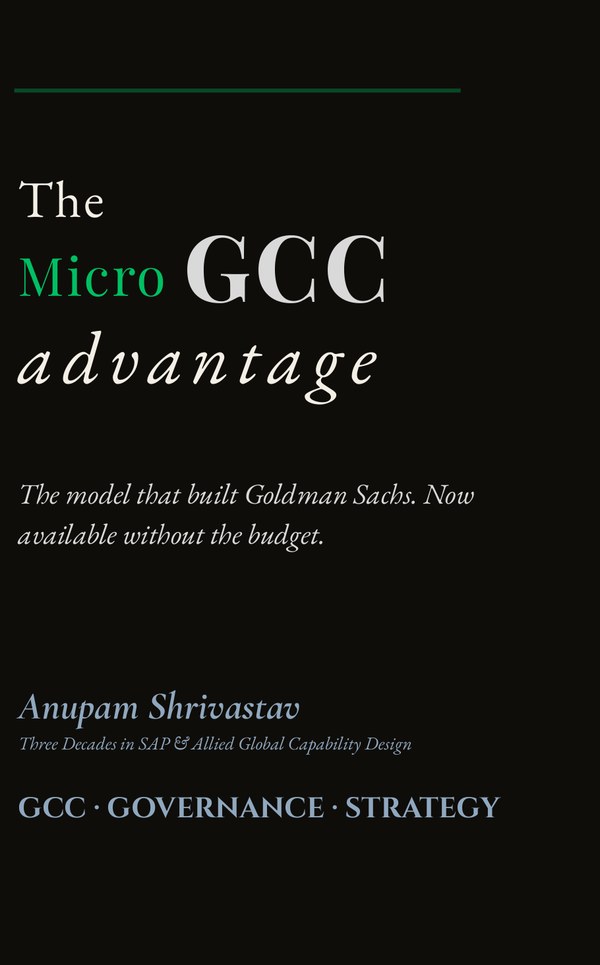
In the model in The Micro-GCC Advantage, a twelve-person micro GCC in Bengaluru costs USD 310,000 to USD 430,000 a year fully loaded, against USD 504,000 to USD 672,000 for equivalent agency-placed staff, a saving of 24 to 38 per cent.
The figures are Anupam Shrivastav's from the book (2026), built from NASSCOM salary benchmarks for 2024 to 2025, JLL India office market data for 2024, the EY GCC compensation survey and direct operational practice. They are modelled, not guaranteed, and they will move with city, seniority mix and work type.
Choose the right comparison
The book argues that the fair comparison is a micro GCC against the agency or body-shopping model. Comparing against hiring the same people at home shows the biggest saving but answers the wrong question, because the company was not going to hire them at home.
The twelve-person model
- Talent. About USD 22,000 to 29,000 a year per mid-level professional including employer statutory contributions, so USD 265,000 to 350,000 for twelve.
- Entity and compliance. Managed entity services about USD 9,600 to 14,500 a year, or an employer-of-record fee of about 8 to 12 per cent of gross salary, plus a statutory audit of about USD 3,600 to 6,000.
- Office. A serviced workspace in Bengaluru or Hyderabad about USD 4,800 to 8,400 a year.
- Management. A part-time India-side coordinator or team lead at about USD 12,000 to 17,000, plus about a quarter of a senior manager's time on the company side.
- Total. USD 310,000 to 430,000 a year, or USD 26,000 to 36,000 per person.
- Agency comparator. USD 42,000 to 56,000 per person, so USD 504,000 to 672,000 for twelve.
- Saving. USD 74,000 to 242,000 a year, which is 24 to 38 per cent.
Why agency rates are higher
The book says the professional's actual employment cost is typically 50 to 65 per cent of the rate a client pays an agency. The rest covers the agency's recruitment, overhead, risk provision and profit, and the client cannot see or challenge it.
Larger teams
- At fifty people the book models USD 1.6 to 2.1 million a year against USD 2.1 to 2.8 million for agency staff, a saving of 24 to 33 per cent.
- At 100 to 500 people the cost per person falls, but governance matters more. At 200 people the book puts the saving at USD 2.8 to 4.0 million a year, with governance costing about 15 to 20 per cent of that saving.
What the model leaves out
These figures are the floor, not the whole picture. They count direct cost only. They do not value retained knowledge, lower attrition or ownership of intellectual property, which the book argues are where much of the real advantage lies. Below the critical mass of about eight to twelve people, governance costs per person are higher and part of the saving disappears.
See what a micro GCC is and how it is set up. This is general information, not financial advice.
All insights