Insights
Build, fix or walk away: deciding what to do with a GCC
Whether to build, fix or walk away from a capability center is decided by three questions asked in order: is there a genuine business case, should the company build or fix, and, for an existing center, is it worth rescuing at all.
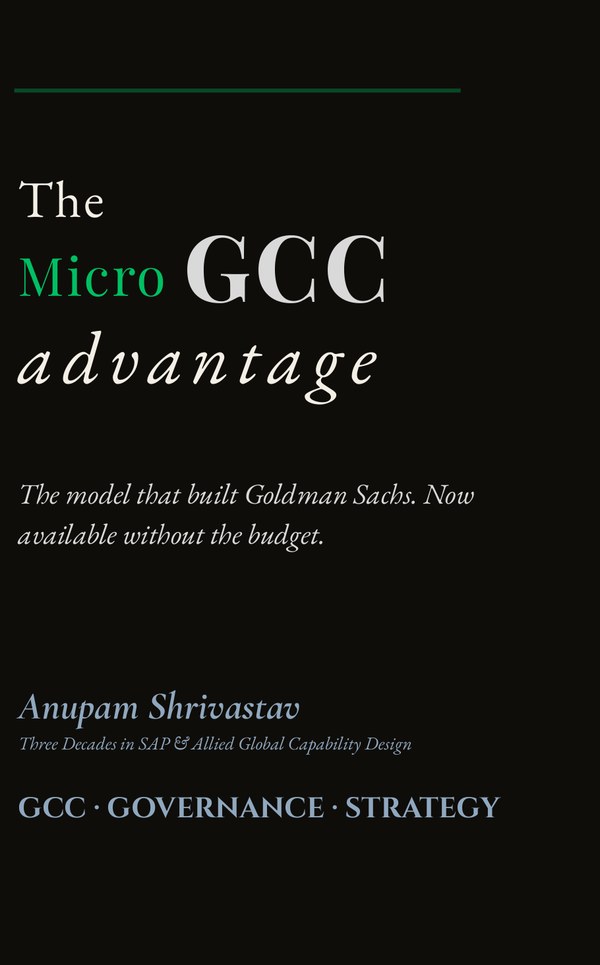
This summarises Chapter Fourteen of The Micro-GCC Advantage by Anupam Shrivastav (2026). The book stresses that the sequence is the framework. Collapsing the three questions into one assessment produces board presentations without decisions.
Question one: is there a genuine business case
The usual business case is built on cost: lower labour rates multiplied across the roles moved. The book calls that insufficient. The real question is whether there is work the company must do continuously, at scale or with deep expertise, that it cannot do as well at head office. If the work can be done at home at comparable cost, or the volume does not justify the fixed costs, a GCC is not the right answer.
Question two: build or fix
Most organisations with a failing center reach for a rebuild. The book argues for asking first whether the existing center, correctly governed, can become what is needed. A center is a candidate for replacement rather than repair if it has run for fewer than three years, has had three or more consecutive years of above-average senior attrition, or sits in a city whose talent market cannot support the mandate. Otherwise fixing is usually cheaper than starting again.
Choosing an operating model
Three models dominate: fully captive, build-operate-transfer (BOT) and a hybrid. The book says the choice is not mainly about cost. It is a governance design problem, and the right model matches the parent company's actual governance capacity. A fully captive structure, which the book puts at nine to twelve months to full readiness, needs real India expertise inside the company. A BOT arrangement only works if the governance of the build phase is designed explicitly.
Question three: walk away
A center is not worth rescuing when one or more of three underlying conditions is present and cannot be resolved. Cost overruns, missed service levels and high attrition are consequences, not the conditions themselves.
- The talent has left. Three or more years of above-average senior attrition in a center whose knowledge lived in those people. The book's test: if fewer than 30 per cent of the people needed to deliver the rescue are still there, the rescue is building on missing foundations.
- The city cannot support the mandate. Every major Indian city has talent, but not every city has the specific depth. A manufacturing engineering mandate cannot be served by a city built around banking talent.
- The parent cannot change. Headquarters will not give up decision authority, or its incentives are built around cost per person. The constraint is then at head office, not in India.
If a closure is the right decision, the book argues it should be handled with documented knowledge transfer and genuine support for the people affected, because the local talent market is small and the company will want to hire there again.
A test for the board
Ask what the company would lose if the center closed tomorrow. If the honest answer is "not much", the question is not how to fix the center but why it was never given the conditions to become worth keeping.
See what a micro GCC is and the glossary.
All insights