Insights
Why the cost case alone fails: what a GCC business case misses
A business case built only on cost fails because it measures what a capability center will cost and has no way to measure what it might become. The savings are real, but a center built only for them stays a cost line, and cost lines are the first thing cut when budgets tighten.
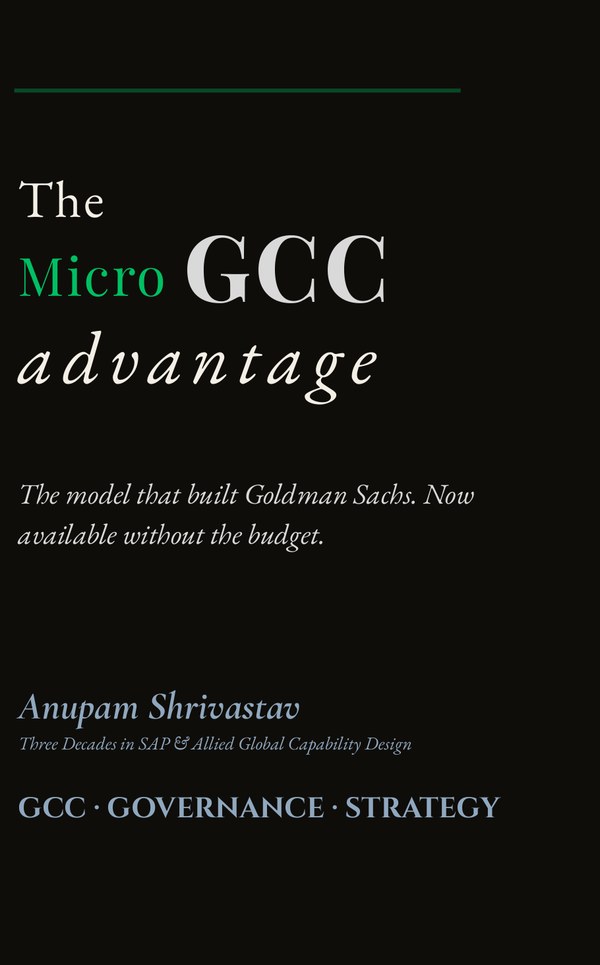
This summarises Chapter Two of The Micro-GCC Advantage by Anupam Shrivastav (2026). The figures are the book's own.
The original business case
The book describes a document found in the archive of almost every large Western company that set up an offshore center between 1995 and 2010. It runs to eight to twenty pages, compares labour rates at home with rates in India (in most versions a difference of 40 to 60 per cent), projects the savings, answers the risk committee on quality, data security, compliance and cultural fit, and recommends going ahead.
The book is clear that this document was not wrong. The savings were mostly realised and the risks mostly managed. The decisions were rational, but made on incomplete information.
What it could not measure
The work these business cases specified was transactional: data processing, software maintenance, help desks, back-office administration, and enterprise system implementations specified entirely at head office. The graduates hired to do it were, the book says, overqualified for much of it.
That raises a question the business case was never designed to ask: if the people we hire can do more than we ask of them, what happens to that extra capability? In the book's words, the business case measured what the center would cost. It had no instrument for measuring what the center might become.
Two kinds of center
- Built for cost only. The extra capability faded away. Attrition was high, because talented people choose engaging work when they can. Centers that treated staff as interchangeable found that staff treated the job the same way, as a transaction to leave when a better one came along.
- Built for the engineers. Where people were given interesting work, their extra capability was put to use, often as improvements nobody had asked for. These centers kept their people longer and delivered more than the original specification.
None of this showed up in the cost comparison table. According to the book, the difference only became visible years later, once the two kinds of center had moved too far apart to put down to chance.
Why measuring delivery alone is not enough
Many centers were run like an in-house vendor: defined functions moved offshore and measured against detailed service level agreements. The book says this model worked, accurately and at the expected cost. What it lacked was any channel for an idea that had not been specified. Where companies did find out whether their people could contribute more, the answer was almost always yes, but it arrived late.
A floor, not a ceiling
The book takes the obvious objection seriously: the savings were real, jobs were created and the model worked. Its answer is that the cost model succeeded and then became the ceiling rather than the floor. Companies that built on the savings ended up with institutions of much greater value. The difference, the book argues, is between a center the parent company would fight to protect and one it would consider closing under financial pressure.
The one decision that matters
Which kind of center a company ended up with depended, the book says, less on its size, its offshore strategy or the local talent than on one earlier decision: what it had decided, before the first hire, that it was actually building. Centers built that way became hard to replace, holding years of knowledge in people who had been there from the start. The book calls that condition the only real protection against the periodic pressure to cut, merge or close. Its closing line on the subject: the cost was the entry price. It was never the argument.
Questions to add to a business case
- What are we actually building: a way to cut cost, or a capability we intend to keep?
- If the people we hire can do more than the scope asks, where will that extra capability go?
- Is there a route for ideas we did not specify to reach the people who decide?
Next: how to decide whether to build, fix or walk away, starting with whether there is a genuine business case, and what a micro GCC is. Terms are in the glossary. This is general information, not financial advice.
Questions on this topic, or a situation you are weighing? Write to hello@altacentpartners.com.
All insights