Insights
Why so many companies still run legacy SAP
Tens of thousands of enterprises still run SAP ECC or R/3 rather than S/4HANA, and in most cases that is a rational decision made for five structural reasons: migration cost, regulation, customisation debt, integration complexity and board risk appetite.
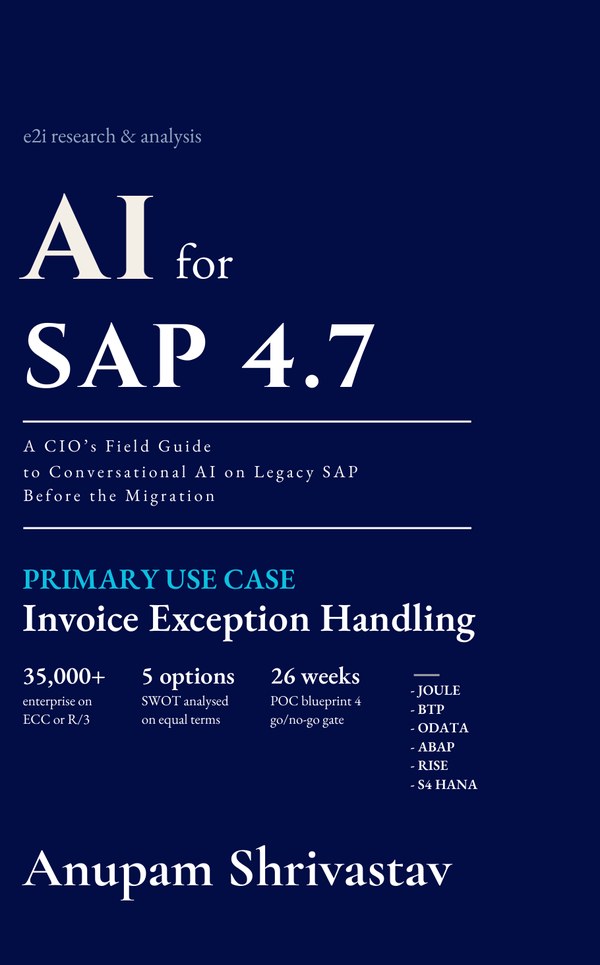
The figures below are taken from Anupam Shrivastav's book AI For SAP 4.7 (e2i research & analysis, May 2026). Where the book cites Gartner, that is stated. The cost estimates are the author's own.
How many companies are still on legacy SAP
- As cited in the book, Gartner estimated that more than 35,000 enterprises worldwide were still active on SAP ECC or R/3 in 2024.
- By the end of 2024, 61 per cent of SAP customers had not migrated to S/4HANA.
- Even after SAP's mainstream maintenance end date in 2027, Gartner projected about 17,000 ECC holdouts.
The five reasons they stay
- Migration cost and complexity. For an enterprise with 1,000 to 5,000 SAP users the book puts a full S/4HANA migration at USD 15 million to USD 80 million over three to five years. Most of it is process redesign, data migration, custom code remediation and change management, not licences.
- Regulation. Defence contractors under ITAR or CMMC face infrastructure rules that complicate cloud deployment. Pharmaceutical manufacturers under FDA 21 CFR Part 11 must re-validate any system that handles regulated data, which the book says takes twelve to eighteen months.
- Customisation debt. SAP R/3 systems built over fifteen to twenty years typically carry thousands of custom ABAP objects, in the book's range 3,000 to 15,000, encoding pricing, reporting, manufacturing and distribution rules that do not map cleanly to standard S/4HANA.
- Integration complexity. Legacy SAP connects to manufacturing, warehouse, logistics, customs, payroll and banking systems built over decades. In complex plants that can run to several hundred connections.
- Board risk appetite. A multi-year transformation is the largest investment, outside acquisitions, that most companies make in a decade. In uncertain periods boards protect capital before they fund programs that pay back over years.
What this means for leadership teams
- Staying on an older release is not a failure. It is a capital allocation decision that thousands of comparable companies have made.
- The risk is that the gap to competitors on current SAP releases, who are deploying AI assistants, widens every quarter.
- Waiting for the migration to finish is not the only way to close it. See AI on legacy SAP before migration for the options.
See the glossary for SAP and GCC terms.
All insights